The Day That Charlie Kirk Died


I also find myself streaming information when the gigantic black truck in the oncoming lane makes an abrupt, signal-free turn into the gas station parking lot to my right. I know that I can’t stop in time, so steer so as to avoid a head-on collision, thinking it safest to spare any passengers and myself from potential death.
It is early evening on September 10, 2025. I am binging live news feeds because the right-wing political activist Charlie Kirk was known to have taken a bullet on the campus of Utah Valley University. Donald Trump had just claimed that he knew Kirk was dead, and I want to know what was actually happening. Never mind that I often teach philosopher Michel Serres’ short tract Malfeasance to emphasize his point that in a world where pollution constitutes biopolitical power, information is the form of pollution contemporary humans ingest the most.
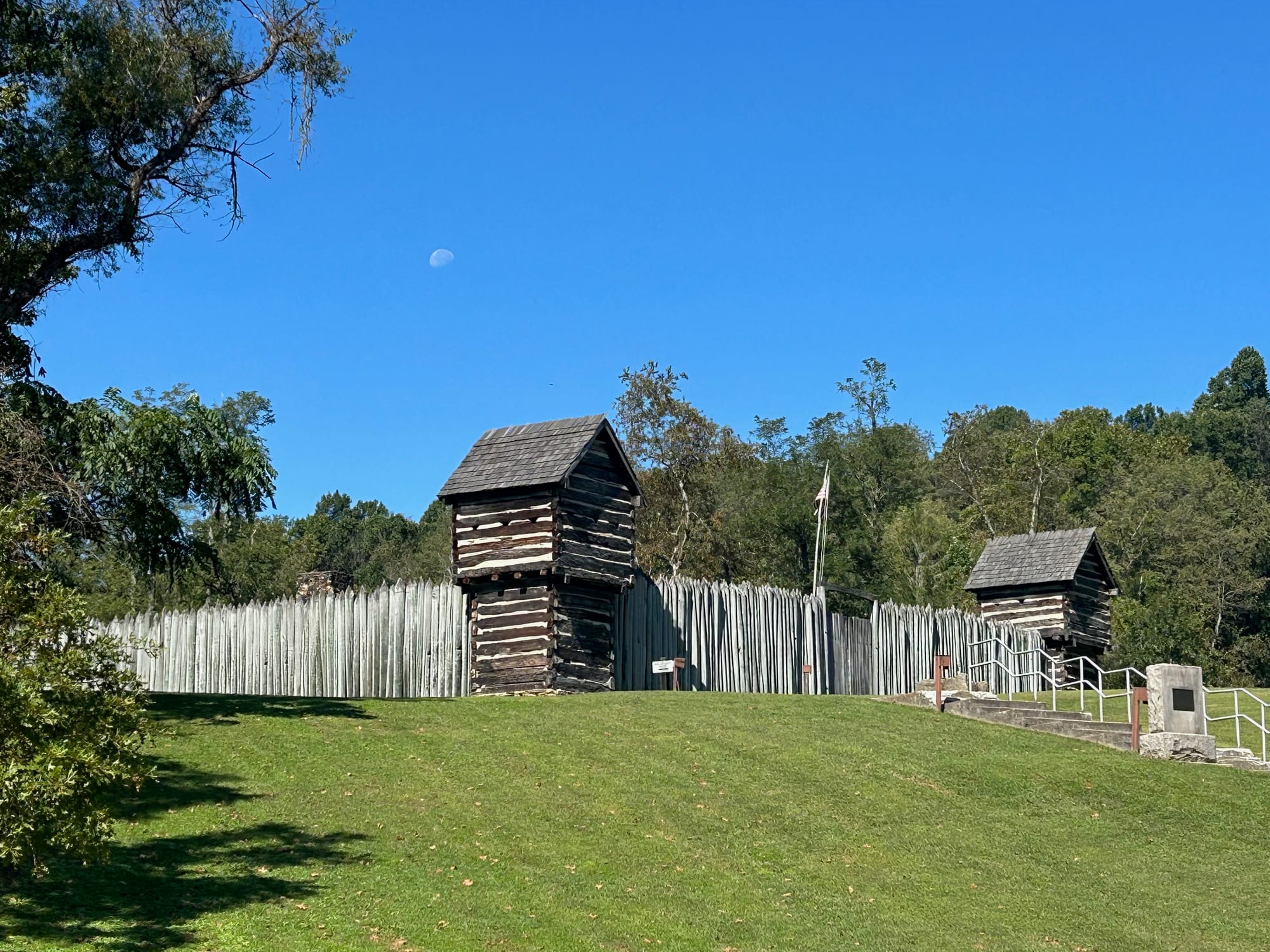
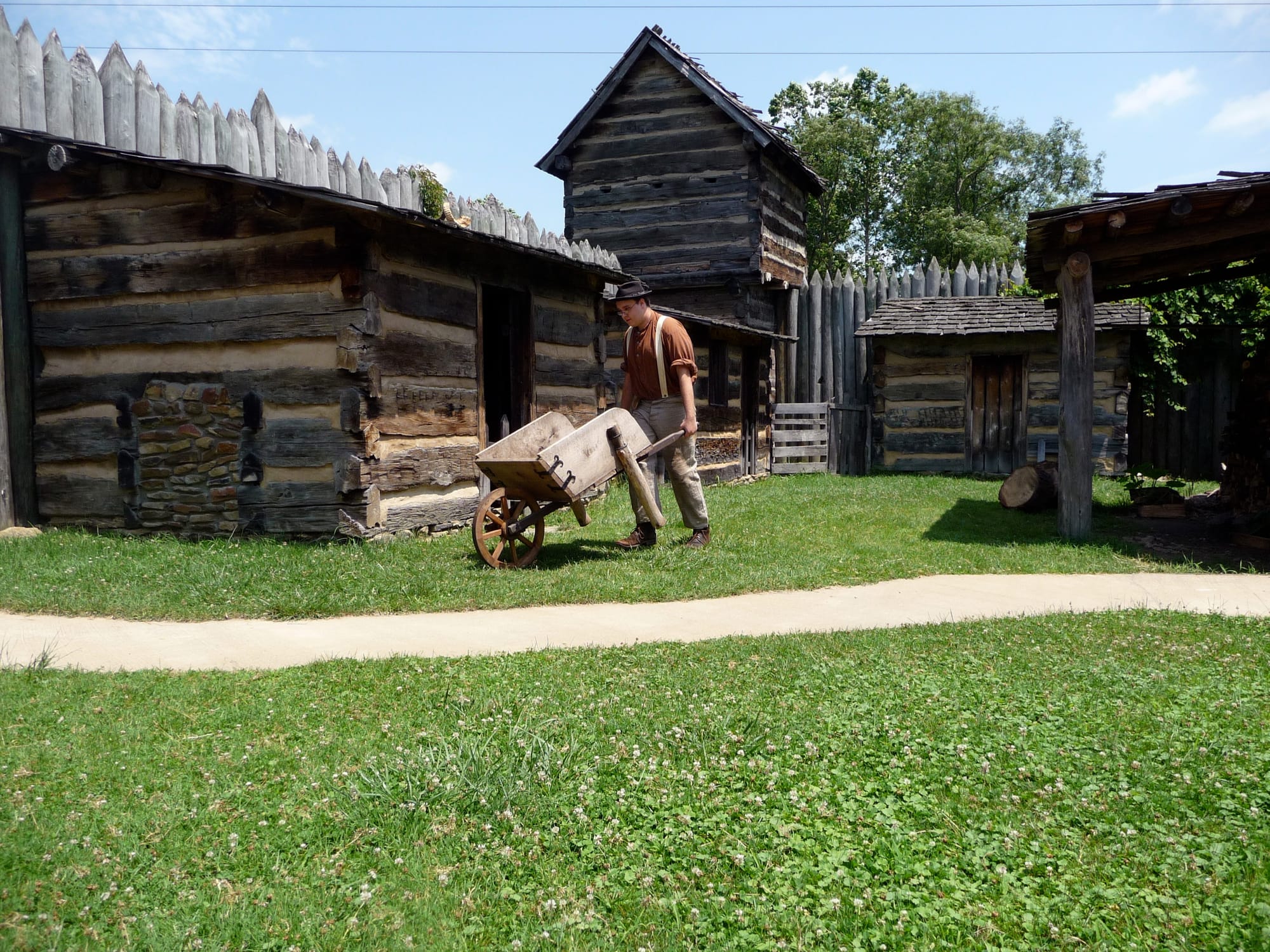
Instead I am in Fairmont, West Virginia on my way to see a reconstructed settler fort called Prickett’s Fort. The 18th century colonial outpost had been reconstructed without any fealty to historic evidence for America’s bicentennial in 1976, so West Virginia could claim a position in the narrative of cleansing the land of both the harmful indigenous people and the British overlords. Prickett’s Fort offers a fully-recreated immersive experience, where people can (or probably don’t) pocket their smartphones and regale themselves with the simulated reality of an innocent, hardy and freedom-loving origin for this decadent empire. Prickett’s Fort existed in the first place because European settlers robbed indigenous people of land the settlers wanted to mine and log and plow via the 1768 Treaty of Fort Stanwix.
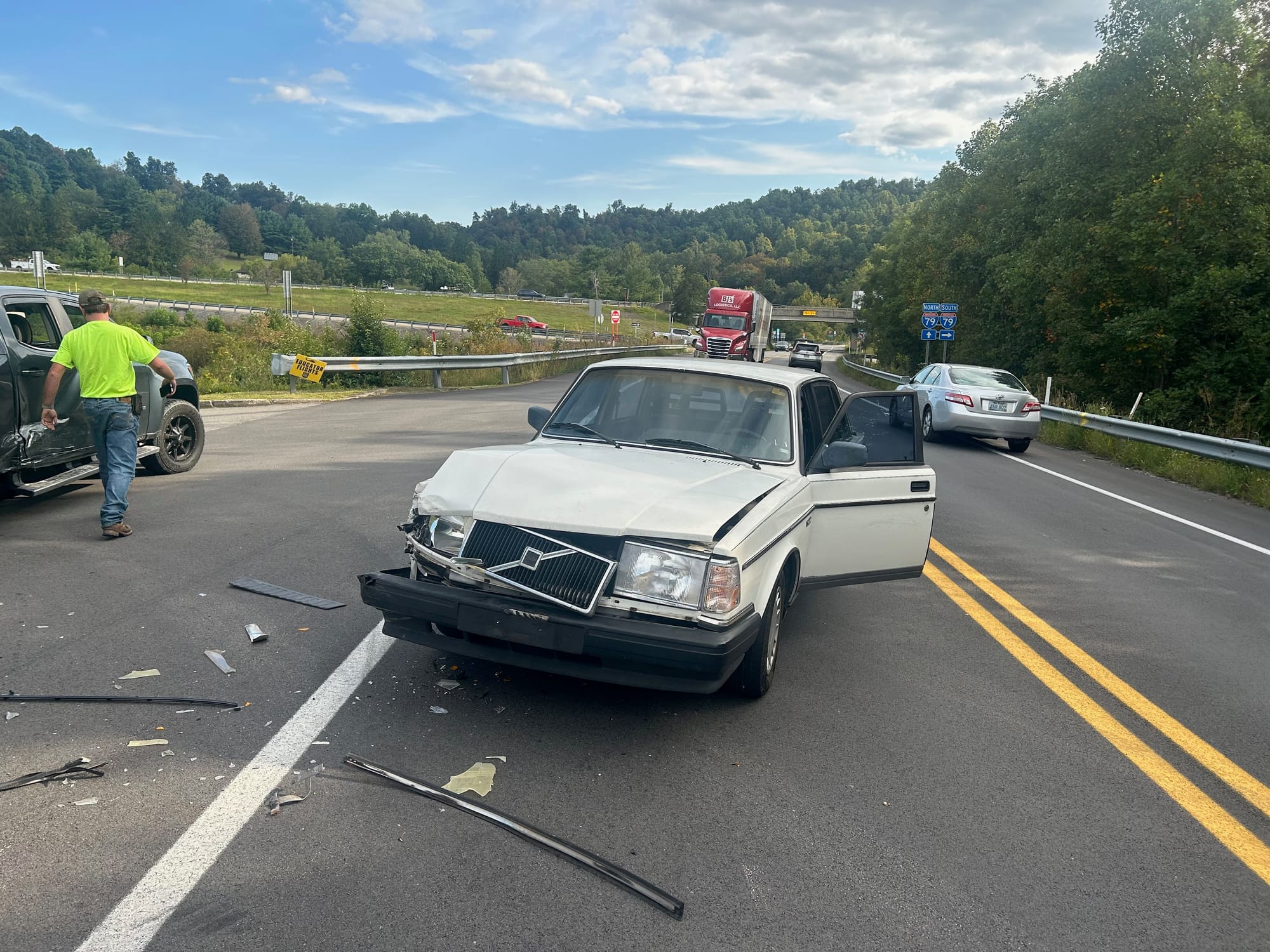
My little white Volvo – a fitting vessel for an outsider academic whose heart rate accelerates faster at the sight of communist housing blocks than reconstructed American colonial forts – turns out to be immobile. I carefully retrieve moldings that I know to be challenging and expensive to locate, but quickly realize that I would not be driving the car out of the accident. Or ever again.
The big black Ford truck sports a wide decal reading “COUNTRY BOY” across the windshield and another decal showing Jesus Christ leaning on a crucifix draped with the American flag altered to carry that ominous blue stripe. Before I prepare to meet the driver, he is out of the cab and right in my face.
“Are you alright?” I ask.
“Mister, you can’t be driving that fast like that. You were going way over the speed limit!”
“Maybe so, but you turned against an oncoming lane of traffic without a signal. Other cars were behind me. You caused this accident, but I am not upset,” I offer sternly but kindly.
The driver, who looks a bit younger than me, seems to be getting angry by my calmness.
“You can’t be driving like that.”
He proceeds to mutter something about getting bait to go fishing, which makes his front-windshield decal an honest proclamation. He also states that his parents own the truck and will be upset.
A cluster of emergency personnel arrive, most off-duty. Standing in my blazer next to my damaged vehicle sporting an anti-fascist symbol on its rear window, I am ignored by most. The other driver begins to clench his fists and scream obscenities at intervals. I continue to collect parts of my broken car.
Finally the other driver’s parents arrive. The father says nothing, but begins making a video of my car and then me. He glares. I check my phone again to see if Charlie Kirk was really dead, but none of the handful of webpages I have open have a conclusive update.
Eventually a police officer arrives, and sensing the animosity which is quietly boiling from the other driver and his parents – despite the fact that they get a spare tire on the truck and it is starting fine – he pulls me to a side of the gas station lot.
“Stay here and I will give you a ride,” he offers. A man named Hippie from a company called Hillbilly Towing moves my old car away, and I get into the police cruiser. I immediate flip through the websites and see that Charlie Kirk seems to be dead.
The police officer takes me to McDonald’s, from which a grad student will later retrieve me. On the ride, we discuss our shared experiences formerly living in Missouri. He opines that West Virginia is a better place than Missouri, because the people in Missouri are absolutely crazy and mean. As a historian of white supremacy’s assault on the Black residents of St. Louis, and someone who has read Miles Davis’ autobiography, I can’t disagree. Yet what is the real difference, I wonder, as I think back to the angry outbursts from a young man whose truck is owned by his parents and who won’t take responsibility for causing what could have been a deadly accident?
The theorist Richard Seymour still maintains that we are not living in an era of fascism, because nation-states do not yet comport to fully post-constitutional authoritarian configurations. However Seymour also observes that we cannot disavow we live in an era where fascism is being normalized culturally, so the teleological pathway to the end of state-protected rights (if, when and where they ever really existed) seems set. To Seymour, the circulation of “everyday paranoia and victimhood” marks the first phase of fascism.
A chance traffic accident yields the rageful resentment of the other driver who claims victimhood despite clear evidence and personal knowledge that the he caused the accident. The police officer needed about ten seconds to assign fault to the other driver, despite his also clearly reading me as an outsider who could easily be made into the deviant alien threatening the local order. I still wonder what is the zero-degree threshold that transforms this kind of encounter into assault or murder. As a white man, I acknowledge that privilege may allow me to only wonder in some cases. Statistics of women and nonbinary people being sexually assaulted, nonwhite victims of police violence and murdered and missing indigenous persons are shameful rebukes to the fallacy of white male victimhood. The threshold is reached every day, many times.
+++
I recall the adage that Donald Trump is not president of the United States of America because of Donald Trump but because of the United States of America. Settlers at Prickett’s Fort have also been recast in victimhood by park narratives – the indigenous self-defense as an “attack,” the British army thwarting a rebellion by people who were supportive of British rule when it served their capital-forming interests—in order to justify their violent domination of the land.
So also Charlie Kirk. I hate to inscribe the thought in the front of my mind since September 10: that the right-wing truly has not made the most of Charlie Kirk’s assassination, which passed from the stage of coherence-myth spectacle to edgelord YouTube comment cudgel fairly fast. Yet there was a moment in which Kirk’s death seemed to be the necessary envelope of victimhood long claimed by Trump, JD Vance and numerous other right-wing elites who have turned lives of Ivy League access into disingenuous fables of suffering in order to prove their righteousness. The response to the death of Charlie Kirk demonstrates that the fascist order came close to achieving a Gramscian hegemony, perhaps wrecked only by Trump’s narcissistic need to discard threats to his MAGA centrality and Erika Kirk’s cloying, truly bizarre interview with Bari Weiss.
The left cannot keep assuaging its lack of mass organization through a series of right-wing failures. At some point after Trump, the project may gain a coherent ability to organize society beyond the short-term dysregulation of its current leader. Literally, we have to claim the discourse. We have to run the pollution of the right and right-friendly, Overton Window-shifting discourses through the gears of a massive consciousness filter. And also the nation-state, at least until we abolish it and replace it with a real North American workers’ paradise.
Charlie Kirk led young people into the fascist project, despite supposed personal virtues and artful signification of minor dissent on Israel’s genocide in Gaza and a handful of other rather riskless breaks from MAGA conventions. His entire self-made, man-with-a-table, free-speech-loving hagiography defies the facts of his own life. Kirk was a pugnacious teenager whose disdain for accountability led him to skip college and run into the arms of adulating millionaires in Chicago, who boosted his career as a youthful salesman of the old alliance of capital and state for which the settler colonizers at Prickett’s Fort dreamed. Kirk was an opportunistic shaman who discarded Tea Party clothes for the MAGA project without moral compunction. He venerated the construction of an American dictatorship while proclaiming himself the embodiment of free political agency.
Kirk public hectoring of anyone who stood for the dignity of fellow humans – trans people, immigrants, Muslims to name a few – perpetuated the founding sins of America. His Christianity did not lead him to implore fellow white men to renounce rape culture or stand against the racist tropes of Donald Trump and J.D. Vance. Kirk’s grinning Everyman demeanor made him a perfect signifier of a power structure erected on the disavowal of a fundamental systematic oppression of human life in the interest of accumulation.
This is a nation that allows accumulation to soar, and turns whatever obstacles lay ahead – nature and its bounty, humans and their opposition, competing nation-states and eventually a flimsy but peace-seeking international political order – into things that could be dispatched. Thingification, as Aimé Césaire called it – the ultimate disavowal of any responsibility for mass murder. Kirk flaunted a freedom based on his own privileges and his alliance with the vampiric powerbrokers who steal victimhood from the people that they actively seek to crush and dehumanize.
+++
I am on foot when I walk to my evening seminar at West Virginia University, which has been moved into a massive science lecture hall because the history department’s building overlooks the field where the local Turning Point USA chapter is holding a vigil for Kirk. I am respectful for the need to mourn, and have no admiration for Kirk’s conspiracy-addled killer. They both seem like two interdependent poles of the fascist consciousness in that each justified political violence by valorizing self-narrated victimhood.
Yet I note that we had a bomb scare less than a week prior, and myself and many students and faculty were never even notified to avoid campus. 233 school shootings occurred in the United States of America in 2025, and my university has never responded to any of them by spectacular displays of vigilance. Kirk’s vigil practically militarizes the campus: helicopters are circling overhead four hours before it begins. Snipers from the state police are set on rooftops.
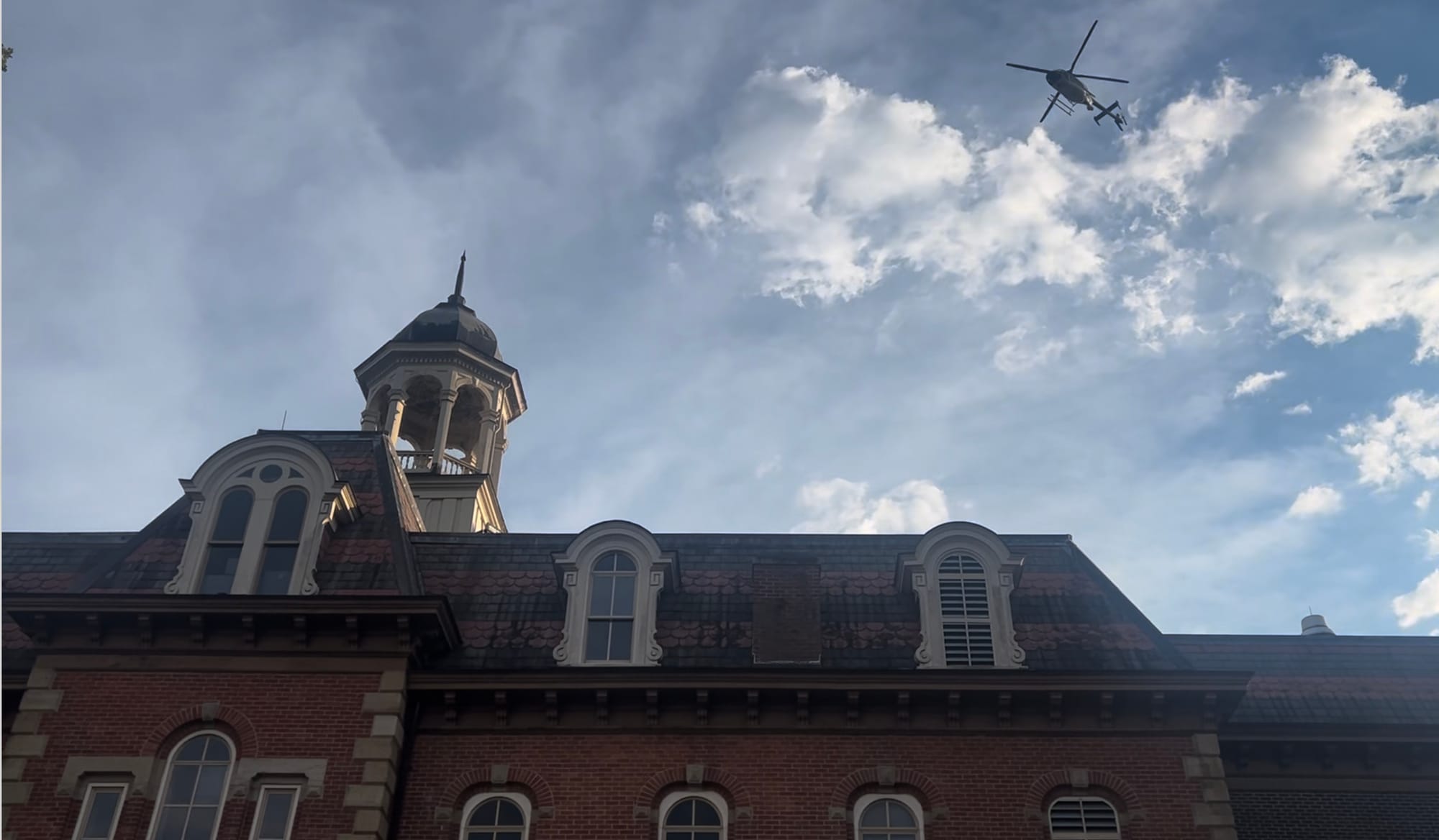
All of this security entourage shows me whose lives matter to my government. Not the students and teachers who could be mowed down by ridiculously common mass shootings. Not the workers who are at risk by working in school environments as janitors and food service employees, who could catch a bullet easily. No, it is Charlie Kirk and his supporters who get the cavalry’s protection.
Many people on the center left fall in line by offering bizarrely accommodating eulogies for Kirk through press releases and social media posts. Some right-wing lawmakers succeed in getting professors fired for posts reminding people that Charlie Kirk’s own public speech includes overtly racist, anti-queer and misogynist commentary. There are threats that denouncing Kirk could become illegal.
The aged, cruel and insane tyrant Trump clearly relished the captivating popularity of Kirk, who at least never faced a microphone to rant about toilet flushing and tar his enemies with vile epithets. Charlie Kirk the mythic martyr was a good man, devoted solely to honest free-speech exchanges with his ideological opponents – a figure who washed the proto-fascist agenda in the trappings of the US Constitution.
I have students who are crying in class the day after Charlie Kirk died. Some others are extolling his free-speech bravery but also insinuating that there are deep conspiracies behind his passing. The space to neutrally observe that Kirk was an ideologue who perpetuated some extremely oppressive views, and essentially brought the more libertarian Tea Party into the MAGA fascist project, seems nonexistent. I still give an interview to the student newspaper using my real name, but the author does not use any of my statements that would lead to harassment.
Never forget that Charlie Kirk created the “Professor Watchlist,” a tool of ideological abuse that has led to doxxing and death threats for his targets. So much for Mr. First Amendment. The Professor Watchlist remains a terrifying weapon of negation, alongside Canary Mission’s kindred lists of professors, students and journalists who oppose Zionist fascism. The goal of these lists is to inflict harm on people’s abilities to feel safe by subjecting them to harassment, firings, doxing and chaos. Yet Kirk presented his list as the needed tool of the neglected far right, supposedly seeing their liberties trampled by a hegemonic leftist power structure in the American academy.
Charlie Kirk’s death shows me that spaces in which I work – universities, journalistic outlets – are actually not safe. The fascist project has captured them, not through professed doctrine but through enabling actions. The concern for security for people mourning Charlie Kirk in a world where Americans can die just by showing up to class, immigrants and others can die just by being alive and laborers can die by showing up to increasingly-unregulated jobs—all show me that paranoia and victimhood discourses as will-to-power hold more powerful than actual paranoia (warranted) and victimhood (too real).
Many public universities in the US now host “civics centers” foisted on them by right-wing state governments, and these centers are inverse Professor Watchlists. Devoted to vague and quite vapid concepts of tradition, American democracy and classical civics, these are spaces designed to usurp the supposedly woke – but mostly toothless liberal bureaucratic – humanities departments harboring radicals. Ohio State, there is the Chase Center for Civics, Culture and Society, where the director is Assistant Professor Luke Perez.
In February, Perez did not like a journalist’s pursuit of questions directed toward former Ohio State University President Gordon Gee’s relationship to billionaire Les Wexner, who hired Jeffrey Epstein to manage his wealth. Gee faces a deposition in a class action lawsuit brought by former male university wrestlers who were systematically sexually abused by a former doctor in a period overlapping both Gee’s presidency and Wexner’s tenure as chairman of the board of trustees.
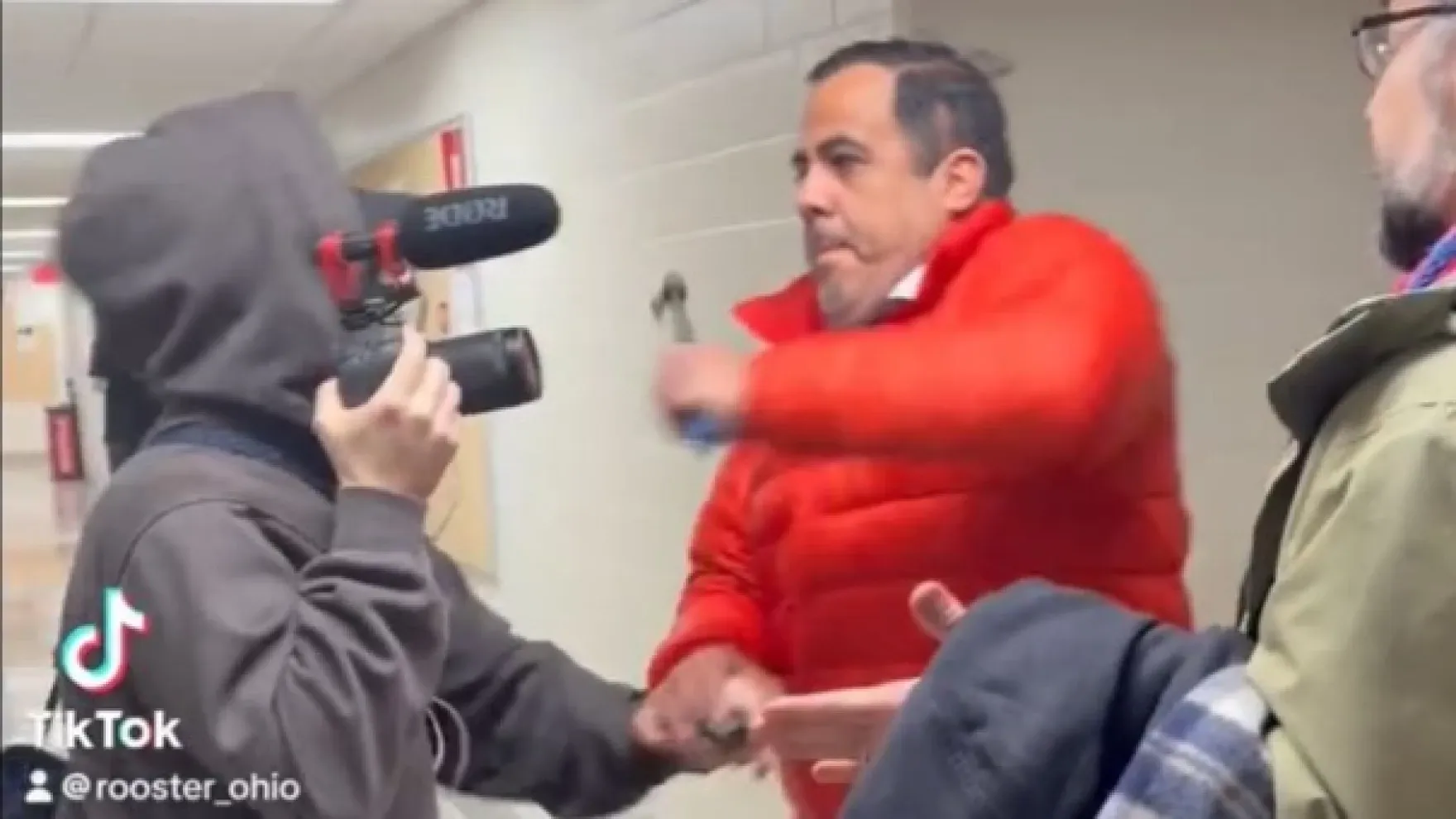
When the journalist ended his questions, another reporter standing next to him walked toward Gee as Gee walked into a classroom. This reporter was asking questions about tuition increases, and had no relationship to the other reporter. Perez – a scholar of the ethics of war and “American Grand Strategy”--slammed the man to the floor, and then shouted a false narrative about the journalist laying hands on him first as he walked off. Perez faces criminal charges despite his cry of victimhood.
The threshold of violence in the case of Perez only becomes more elusive in the video showing the assault. It seems to come from nowhere. Yet it came from inside of Perez, and it arrived when he perceives that someone is calmly using their free speech to question a powerful man’s complicity in dehumanization.
We can’t win the world back by co-opting the toxic self-narration of the fascists. We must not yield to their worst instincts, or our own. Every act toward the future builds the next world, which is why online spaces – including many supposedly “left” – are horrendous extensions of the unvanquished American political economy of thingification. Being rational and honest, though, may be insufficient as well. We never know when our remaining calm and truthful will result in our heads being blown the fuck off. Yet we must press toward the moment when it won’t.
Parts of this essay originated in Extr/activism: Claiming the Possibilities of the Present Age, a performative lecture hosted by the School of Nonfunctional Studies on February 12, 2026 at Bivy in Anchorage, Alaska.