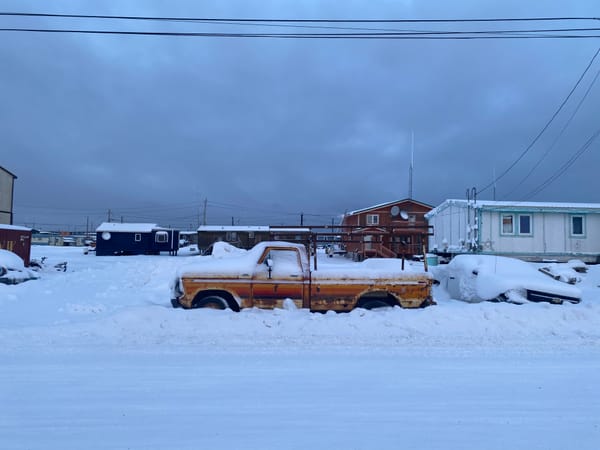
The Street Versus The Homeland

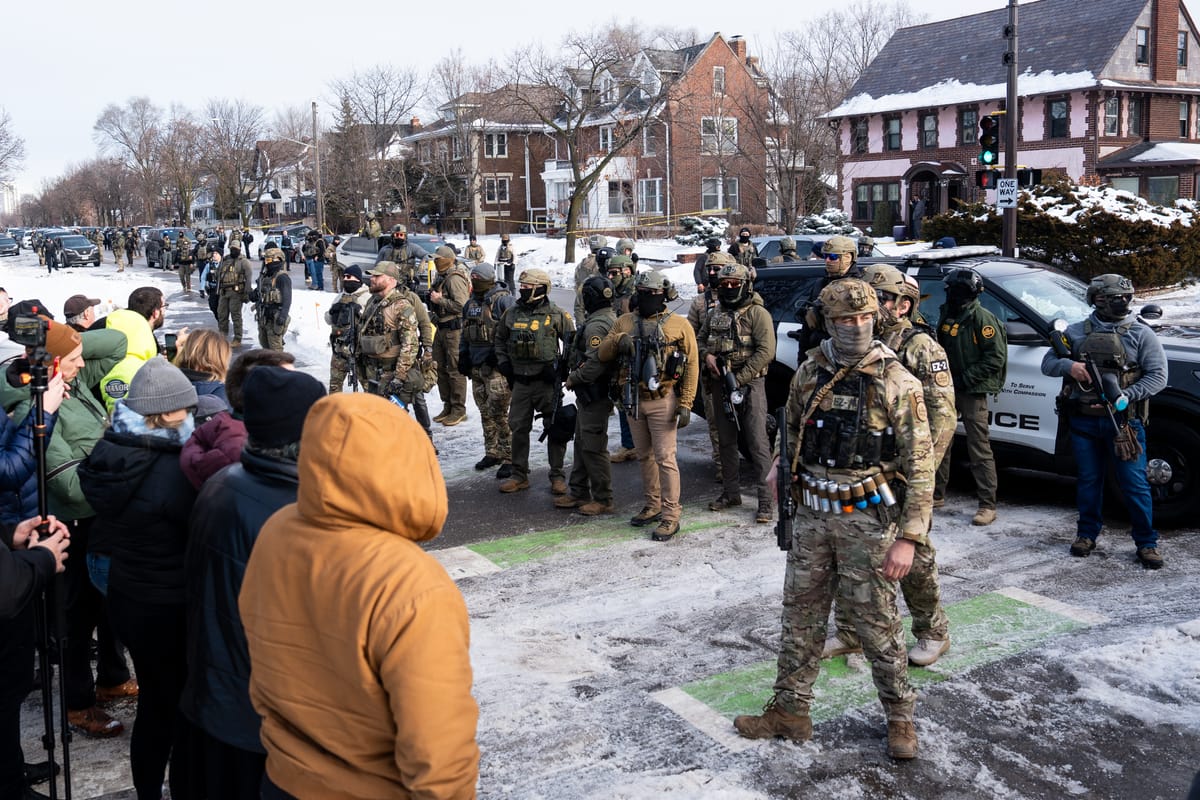
Minneapolis, 2026
By asserting her right to obstruct an American city street, Renee Good met her murder.
This positioned her claim on the nation state against the one made by the current rulers in a highly symbolic political space. President Donald Trump’s white nationalist neo-fascist state aims to control flows into and out of the nation as well as the public behavior of ordinary people witnessing his government’s abductions of workers in plain sight. Minneapolis, with its genial white population openly integrating Somali and other immigrants—in a pattern more and not less like most American metros, both presently and historically—presents streets of a diversified people making an ever-changing society together.
Perhaps Trump targeted Minneapolis’ streets because of their visual rebuke to what Ta-Nahesi Coates has termed the ethnically-cleansed “Homeland,” the white supremacist, stratified, authoritarian-statist America sought by the Make American Great Again ideology. The immigrant-enlivened, multi-racial Midwestern cities betray the MAGA refrain that coastal elite liberals with their permissive racial and sexual attitudes have ruined the Homeland. Minneapolis demonstrates that the Homeland exists almost nowhere in lived reality, and instead is a pathological mythology aimed at radical disruption of the social relations of the nation rather than at any restoration.
The Homeland’s enemy is the public space of the street, where mobility and encounter occur without the control of the ruling order – where white Midwesterners welcome their new neighbors with such vigor that they will take action against their warrantless disappearances by the immigration federal agents acting literally as guardians of “Homeland Security,” a name inscribed by President George W. Bush and Vice President Dick Cheney in 2002 as the rally for a more quietly racialized order than Trump’s loud MAGA roar.
MAGA is so threatened by democratic assembly on the streets of Minneapolis or the comments sections of videos of Immigrations and Customs Enforcement (ICE) abuse and murder that they swarm both. The streets are swarmed by armed thugs deployed randomly, whose appearances and disappearances are designed to maximize insecurity and crush open rebellion. Online, troll farms and bots deployed from India, Russia and other places gin up pro-MAGA sentiment and suggest that Trump’s government has deep internal support. The Homeland can only materialize through force and farce. The street remains real.
ICE Agent Jonathan Ross murdered Good with clear premeditation, topping off his cowardly act with a misogynist proclamation. Good simply maneuvered her vehicle to attempt to impede the flow of ICE agents on a residential street, so as to protect people she understood to be her neighbors. Carbound cowboys, the ICE agents could have driven around Good’s vehicle, or changes routes. Good’s defiance was modest but firm, and represents a watershed moment in a slumbering nation’s still too-slow confrontation with the neo-fascist authoritarian government of President Donald Trump.
All Renee Good decided to do – like Alex Pretti after her – was to locate a practical act to negate the power of a corrupt state. If people are supposed to be the change they want to see in the world--per the axiom that is widely pronounced except when people actually try to be that change, when qualifications are asserted even by supposed progressives—Good embodies that categorical imperative. She calmly positioned her vehicle, knowing the propensity toward violence that ICE has demonstrated and the entire history of policing in the almost every nation has all but assured falls on anyone who acts like that. When Ross and his other agents confronted Good, she was polite and unflappable—not scared.
Good enacting the power to control the street against the actions of a de facto state political police earned her an immediate death sentence from the government. Had Good backed down, or showed any sign of submission to the state, the officers may have yielded. US Customs and Border Protection (CPB)'s Border Patrol agent Jesus Ochoa and officer Raymundo Gutierrez killed Alex Pretti when he decisively remained filming their mistreatment of another person had let him go days earlier when he impulsively kicked in one of their vehicle’s taillights. The strength of an ordinary resister not folding under pressure imbalances the insecurity of a widely unpopular, post-constitutional government. The semiotics of control nearly demands that officers serving the state immediately kill, or at least gravely harm, such individuals – lest the defiance becomes widespread.
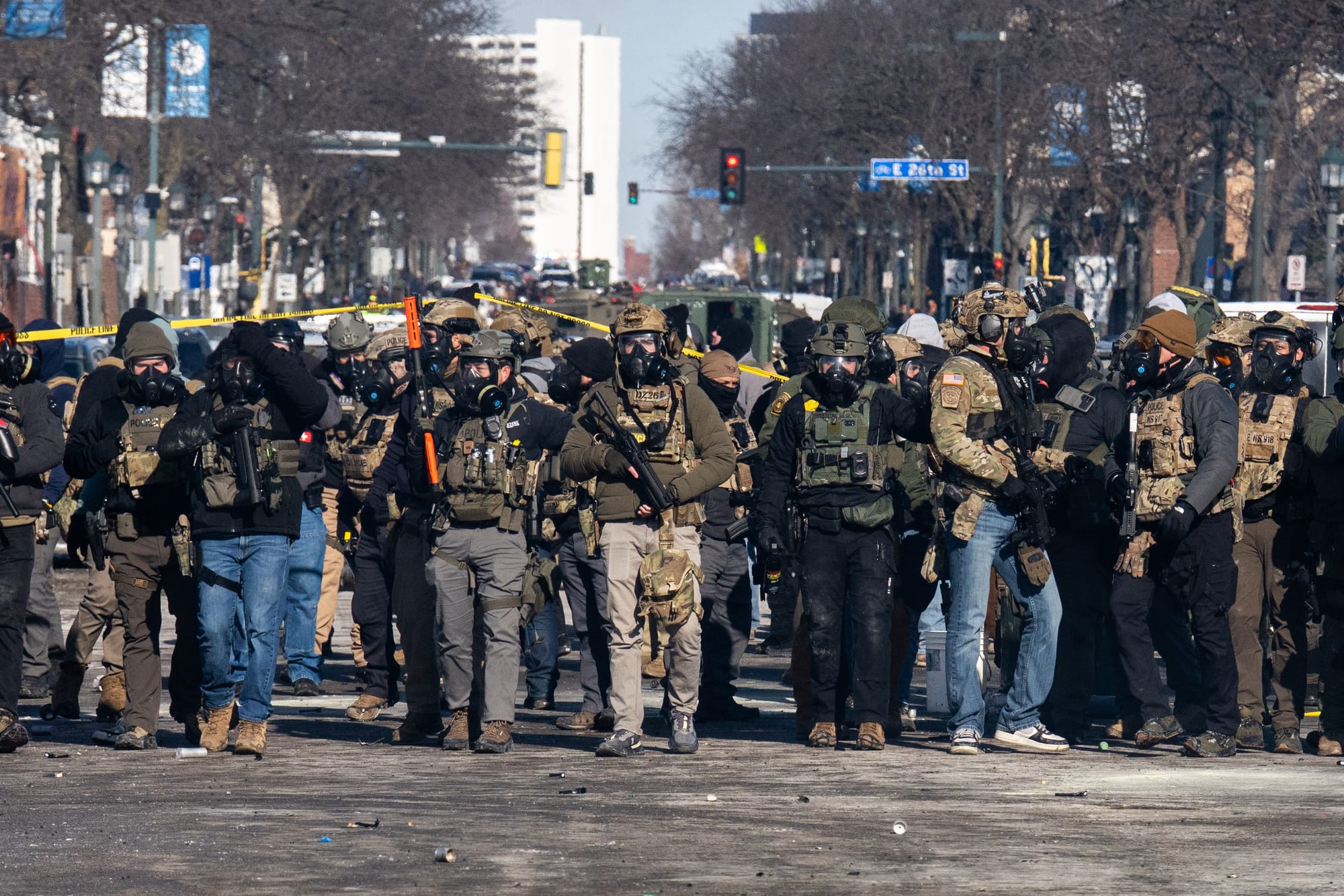
Immediately, Secretary of Homeland Security Kristi Noem, Vice President JD Vance, White House Deputy Chief of Staff and Trump launched into the requisite othering of Good and Pretti, defaming each as a “domestic terrorist” and, in one foul ejaculation by Miller, Pretti as an “assassin.” Trump’s own pardoning of the right-wing mob that tried to overturn the election – and thus the nation’s government – on January 6, 2021 is just an ironic precursor to Trump and his minion’s hypocritical invectives. The state thinks it possesses the swagger of sovereignty by “state of exception” articulated by Giorgio Agamben and prescribed by Carl Schmitt, yet its Big Lie spinning seems effective mainly at driving the tenor of the right-wing media dross-scape and what stories CBS News will dutifully censor or pull from broadcast.
Trump’s narratives ensure that the Homeland is ably protected and its defilers named as enemies of the state. With the number of “illegal immigrants” now incarcerated in the US greater than the number of people Nazi Germany had placed in concentration camps in 1939, perhaps Trump, Miller and their gang feel like the maintenance of power is secure. Maybe it will prove to be. Yet the dissonance between the state’s narrative control and the ordinary people's active negation of that control seems destined to expand.
In Minneapolis, ICE and CPB executed two people whose fortitude symbolically threatened the fragility of state dominance, but they did these things in plain sight. Unsurprisingly, the theatrical displays of immigration raids have drawn protestors, observers and bystanders. There are murder witnesses and murder videos. Through viral distribution, inexorably the videos have been seen by millions of people around the world. Millions of people are now virtual witnesses who can compare the Big Lie cover-up by Trump’s administration to what they have seen themselves. Good and Pretti were out in a street populated by millions of eyes. ICE and CPB are outnumbered far more than they realize.
As Jessica Klanerud writes in Struggle for the Street: Social Networks and the Struggle for Civil Rights in Pittsburgh (2017), social networks around urban unrest and rebellion have always been both physical and intangible. Activists in the last two decades have been able to layer the social networks of streets – protestors, legal observers, individuals willing to buck police power – with online channels of communication and visual broadcast to social media. Assembly occurs on the street but the space of the street consists of layers of reciprocal communications between a physical space and its representation online.
The all-out assault on American university demonstrations against the Israeli government since 2023 has shown that oppressors understand both that what happens on the ground and what happens in the cloud are interconnected, but also that they have been ineffective at squashing social movements because they cannot control all possible loci of assembly. What they have done largely is try to “off” the Renee Goods and Alex Prettis who are willing to face down donor-driven campus police, media-driven doxxing and “professor watchlist” harassment, illegitimate deportation orders and top-down face-saving suspensions and dismissals. These examples have harmed people, but the assemblies against the genocide – and the US support for it – have only grown.
Since 9/11, the federal state in the US has invested in increasingly prefigurative modes of digital surveillance, now including facial recognition and predictive models. Liberal reformers played into this agenda of disempowering street politics by advocating for police body cameras, which now are research devices for learning about pretty much anyone who shows up to confront or observe police officers. Apple recently purchased Israeli tech company Q.ai for $2 billion so that it can own an artificial intelligence program that detects and analyzes “facial skin micro movements.”
One could make an obligatory reference to the concept of “pre-crime” from Philip K. Dick’s Minority Report, but Q.ai seems like a faster way to process the volume of faces that eluded the FBI’s COINTELPRO and that municipal police detectives like New York City’s notorious “Red Squad” have been doing for decades. If surveillance was a superpower, the mass of human beings willing to stand up to a tyrannical government would no longer exist. Instead, “Minnesota nice” mothers and nurses are laying their lives down before fearful murderous federal agents. Yet the policing of dissent aims to disable enough people to arrest mass movements before they start. Disunited actors can be dispatched on the spot, one way or another, and the state can claim it still owns the streets.
After Renee Good’s murder, residents of her neighborhood built barricades to keep ICE and CBP agents out. The residents turned to a historic spatial technology of asserting democratic rights—closing a street. This social conversion of a thoroughfare into an instrument of controlling police famously led to the reformulation of the street under the direction of Baron Georges Eugene Hausmann in Paris between 1853 and 1870. Historian Eric Hazan detailed the perfection of the political use of the barricade in Paris in his volume A History of the Barricade (2015), in which he expounds on the long set of episodes in which the narrow streets of the French capital proved easy to block against militias and royal armies.
Hausmann’s picturesque boulevards unified Paris visually while also crafting a network of distributing riot controlling police or soldiers. The residential street in Minneapolis proved easy to block, but the backdrop of much of the drama there, Lake Street, is more of a Hausmann construct. Washington, D.C. is built on a system of streets much like the reconfigured Paris, demonstrating that the founding fathers who surrounded themselves with enslaved people often living in close proximity knew that spatial control was essential to the rule of their state.
The liberation of those enslaved people in the US required the engagement of every street in the nation in a Civil War. The failure of Reconstruction to truly abolish the chains has required occupation of many streets many times, from the 1910s against white murderous mobs in East St. Louis, Tulsa and Chicago to the 1960s civil rights marches to the 2010s uprisings in Baltimore, Ferguson and other cities. Later efforts at closing streets against police violence would entail more discrete versions of what Sylvia Federici characterizes as “experiments in self-provisioning.”[1] The people always must become their own state, when relegated to the position of the part that has no part in government. The first place for the new state to declare itself usually is the street.
The Minneapolis barricade was short-lived. On January 8, after its construction, the state-friendly propagandists at FOX News declared the neighbors who wanted to safeguard their neighborhood against retribution and escalated raids as “agitators.” The next day, the Minneapolis Police Department removed the barricades, even as Minneapolis Mayor Jacob Frey, a Democrat, made the media rounds to declare that he would be as defiant against Trump’s state as Renee Good had been.
Frey defied police reform in the wake of George Floyd’s 2020 murder by the Minneapolis Police Department, whose officer Derek Chauvin was eventually convicted of manslaughter. In the uprising that followed Floyd’s death, Frey adhered to a narrative of why denying oppressed people and their allies the right to the street was essential to preserving his municipal government’s sovereignty, couched in more gentle language than Trump and his hatchet people’s crude pronouncements.
Still in the context of a president seeking to use federal agents against a state and a city, it is better to witness the mayor and governor make an emphatic defense of their people’s right to the street against the federal occupation, no matter their past inconsistencies. Without their own state, until their own state – the people have to agitate the layers of state above them toward their ends. All elected officials deserve critique and none deserve submission, but when the people can pull the chain and yank the official – that pull needs to be celebrated as a pull. But praise the people, not the official. Even Republicans are now calling for investigations into Pretti’s killing, and celebrating the removal of “turn and burn” CBP Commander Greg Bovino from Minneapolis – but only in hopes that the Homeland remains in control of the streets.
St. Louis, 2014
By asserting his right to belong on his neighborhood street, VonDerrit Myers, Jr. met his murder.
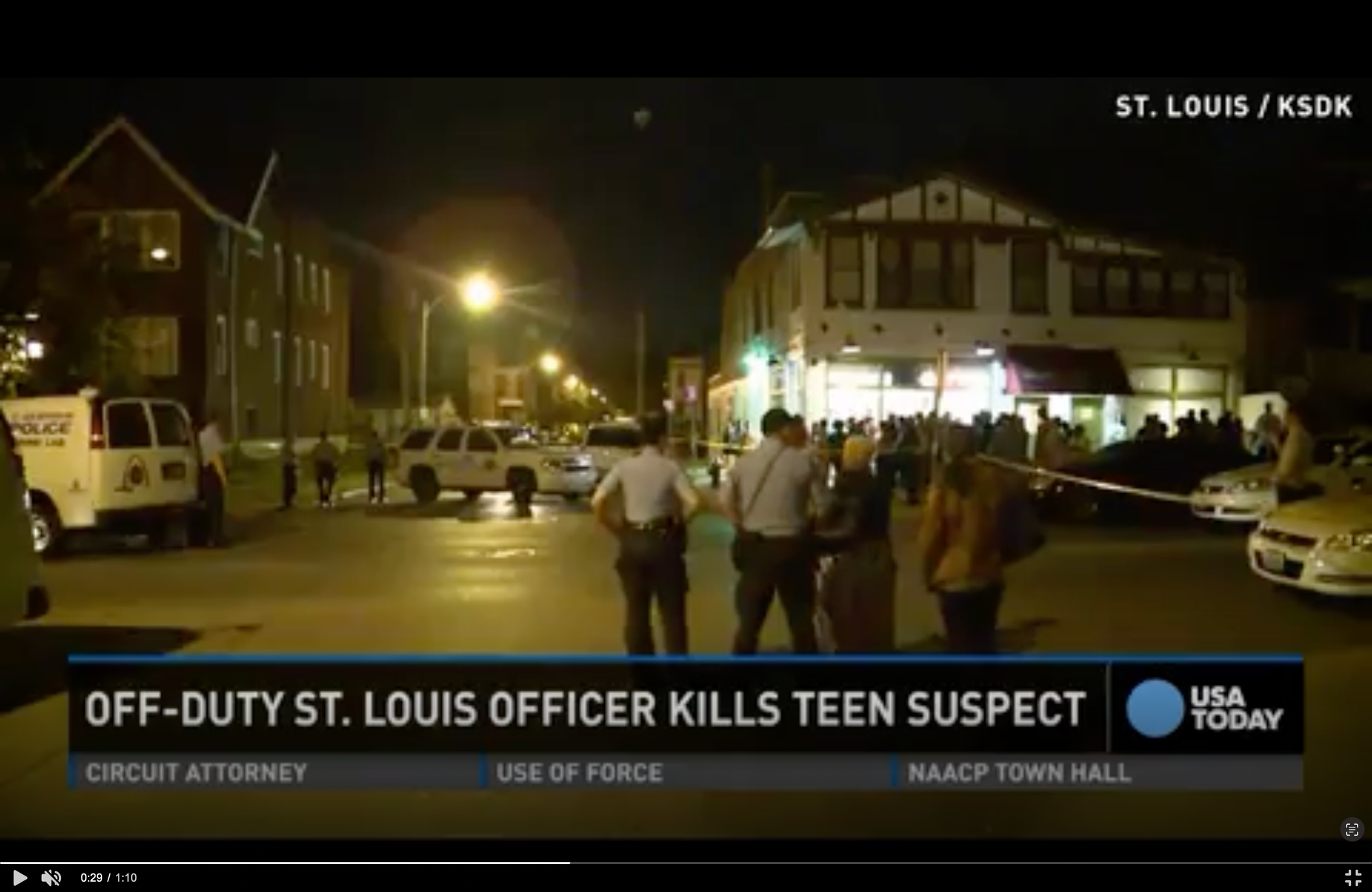
On October 8, 2014, 18-year-old Myers was walking down Shaw Boulevard in St. Louis’ Shaw neighborhood. Myers had just purchased a sandwich, which apparently looked like a weapon in the evening haze to off-duty St. Louis Metropolitan Police Department officer Jason Flanery – at least that was Flanery’s later defense. Flanery was working a “secondary” job as a private security agent protecting the nearby elite semi-private street Flora Place, but the shooting occurred three blocks from Flora Place. Flanery’s insistence that a sandwich resembled a gun came to my mind recently when I watched pro-Trump network Newsmax propagandist Greg Kelly mockingly brandish a black iPhone to suggest that Alex Pretti’s death could have been justified since his cell phone may have looked like a gun.
Myers was gunned down for the apparent offense of being a Black teenaged male enjoying his right to a neighborhood governed by an extra-juridical private police force. Myers’ death came just two months after the cowardly police officer Darren Wilson killed 18-year-old Mike Brown in nearby Ferguson, Missouri with lethal shots fired behind. The prosecutors who investigated Wilson and Flanery were both Democrats, and the settings similar to the political backdrop of Minneapolis. Yet neither prosecutor pushed for the sort of justice that Democratic liberals in Minneapolis are now demanding for the admittedly invading federal officers.
Both St. Louis County Prosecuting Attorney Bob McCulloch, who investigated Wilson, and St. Louis Circuit Attorney Jennifer Joyce, who investigated Flanery, led grand jury processes that ended with no true bills of indictment. A free man in May 2015, Flanery crashed his police cruiser on an interstate that October, refused a breathalyzer but submitted to a blood draw hours later that showed massive levels of alcohol and cocaine in his system.
The tragedy of VonDerrit Myers, Jr.’s death offers a salubrious dialectic point to the two Minneapolis murders, because it happened in a system sustained, nurtured and defended by liberal Democrats. The Shaw neighborhood could well be Minneapolis’ Powderhorn Park, with its tree-lined streets flanked with stately single-family foursquares and lovely apartment blocks – many of whose lawns have variably sported “Black Lives Matter,” “Trust Science” and other anti-MAGA, anti-Homeland rhetorical slogans. No doubt there are anti-ICE yard signs these days, but do any sport anti-Flora Place private police placards?
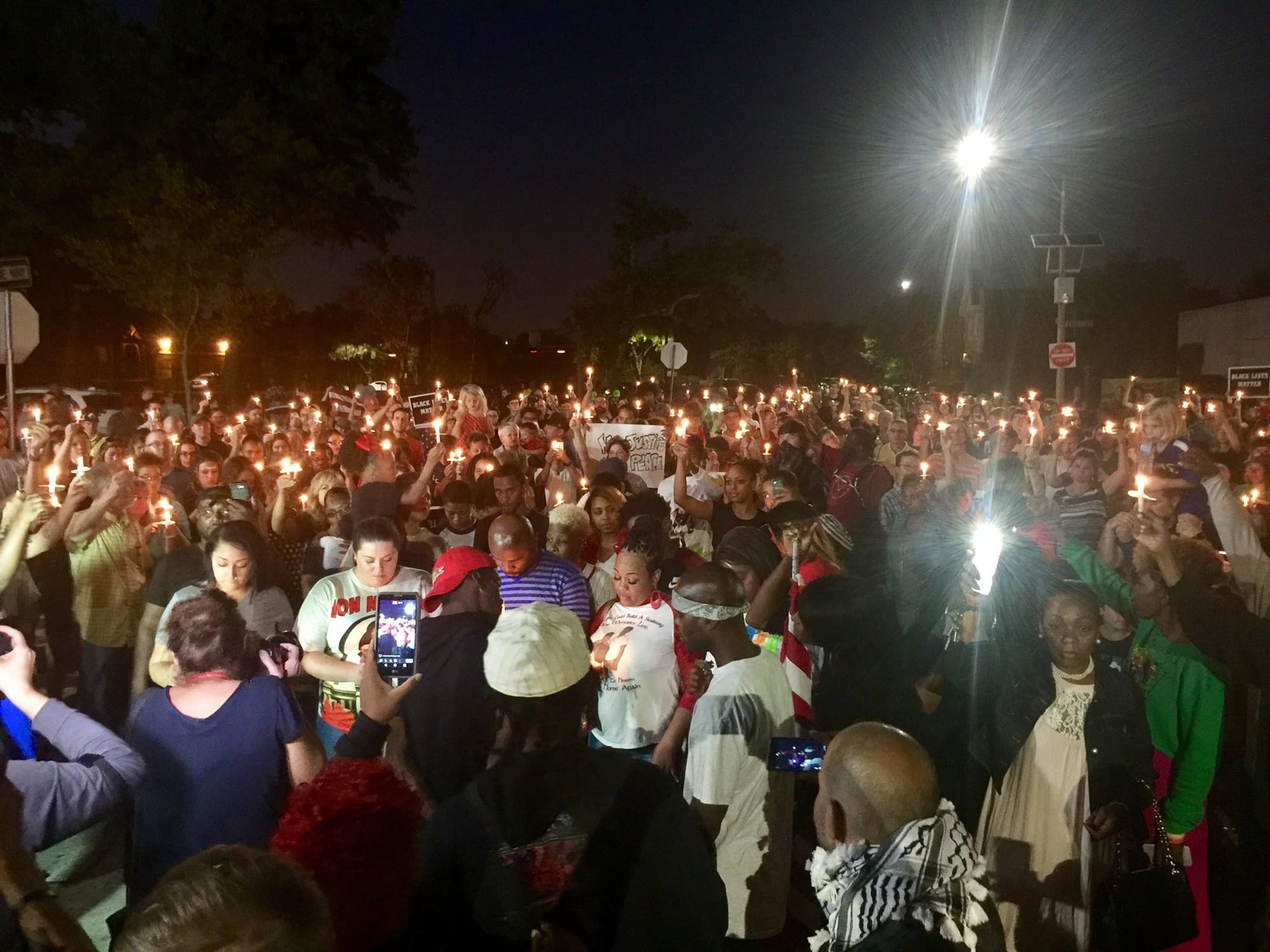
Shaw also undermines any claim that the street is an inherently liberatory device. The neighborhood was once land owned by the eponymous Henry Shaw, an English-born hardware merchant who enslaved Black people to work at his country home of Tower Grove, for which the neighborhood’s farmers-market-sporting Victorian era walking park is named. Enslaved persons at Tower Grove famously escaped in 1855 to be led across the Mississippi River to Illinois by the abolitionist Mary Meachum. Shaw built a botanical garden at his country home for which Flora Place was originally the entrance road. His gift of Tower Grove Park to the city of St. Louis in 1868 included the provision for a private board that persists to this day, showing that control of free movement in cities is hardly a modern idea.
The Shaw neighborhood was platted on the grid plan first established in St. Louis by the French colonizers in 1764. Their original plat for the village of St. Louis repeated the common North American French adaptation of the plan of the bastide, or the fortified villages built across Aquitaine, Gascony, Languedoc and other regions of France (as well as England and Wales) in the 13th and 14th centuries. The bastide project was led by the Count of Toulouse and offered a scheme by which new cities created opportunities for peasants and artisans to become property owners and escape feudal rule by local barons. In exchange, largely, they became subjects of the emerging nation-state of France. The bastide emulated the Roman Empire’s castrum in orthogonal plan and administrative and property-producing purpose.
Although St. Louis did not adopt a public law making streets the common property of the city and its people until 1867, the street arrived as an instrument of making subjects for a nation-state’s indirect rule. St. Louis was the origin city for the “private street” in 1851 when its elites devised a private street owned by the wealthy property owners building mansions along Lucas Place. A private street did not have to even pretend toward common law rights of passage or use. The Shaw neighborhood’s development in the late 19th and early 20th century extended this use of streets to provide circulation and demarcation around parcels of land creating both owners and tenants – and, through racially restrictive covenants, a subjectivity of a part who had no part in the project. Under the Homeland regime, legal citizenship is the new exclusionary mechanism from belonging to the state, but it arrives at one end of a long history of using the denial of property rights to effectively create the same position as well as its governance by state violence.
In 1968, a new interstate highway – I-44 – was routed as an effective barrier of the Shaw neighborhood from the mostly-Black McRee Town neighborhood to the north. Shaw was integrated on the whole, but its white residents were mostly located along the grand Flora Place and in southern and western pockets. The Black residents were closer to the interstate and McRee Town.
In the 1980s, the Shaw Neighborhood Improvement Association was created to guide rehabilitation in the neighborhood, but its leadership was mostly white. The rehabbers and residents of this period espoused agreement with the Jane Jacobs view of granular urbanism, in which more people equaled “eyes on the street” capable of making a neighborhood safer. Jacobs’ concept has an uncomfortable adjacency to the contemporary Homeland worldview, in which a dominant set of people who “belong” can determine the compatibility of pedestrians on the street with the neighborhood. Nevermind that some of these pedestrians could simply be new renters, or residents unknown to the “eyes” on the street, or just people using the city streets that belong to everyone to traverse the neighborhood to a destination.
There is a story told by long-time residents in Shaw that when the Shaw Neighborhood Improvement Association debated whether to close the streets at the east and west end of the neighborhoods, they invited Mayor Vincent Schoemehl—whose administration eagerly pursued the “defensible space” theories of Oscar Newman, who had taught at Washington University in St. Louis—to adjudicate the outcome. According to the story, the mayor asked the priest of the neighborhood Catholic church if he had a television set, and after learning that he did, the mayor adjourned to watch an NFL football game. He told the priest to line up proponents and opponents of street closures on opposite walls of the church assembly hall and to count. Apparently when the mayor returned, the number in favor prevailed.
Shaw’s western streets are simply closed by cul-de-sac closures. Its eastern streets are impeded by a set of closure gates, one-way loops and other measures of preventing through access. Flora Place is closed on each end, but still open for north-south circulation. The underpass beneath the interstate to McRee Town was considered for reopening after McRee Town gentrified and reverted to majority-white in 2015, but by then the McRee Town newcomers favored keeping the street closed because Shaw was more integrated despite a 400% decline in the acceptance of Section 8 housing vouchers in the neighborhood between 2000 and 2014.
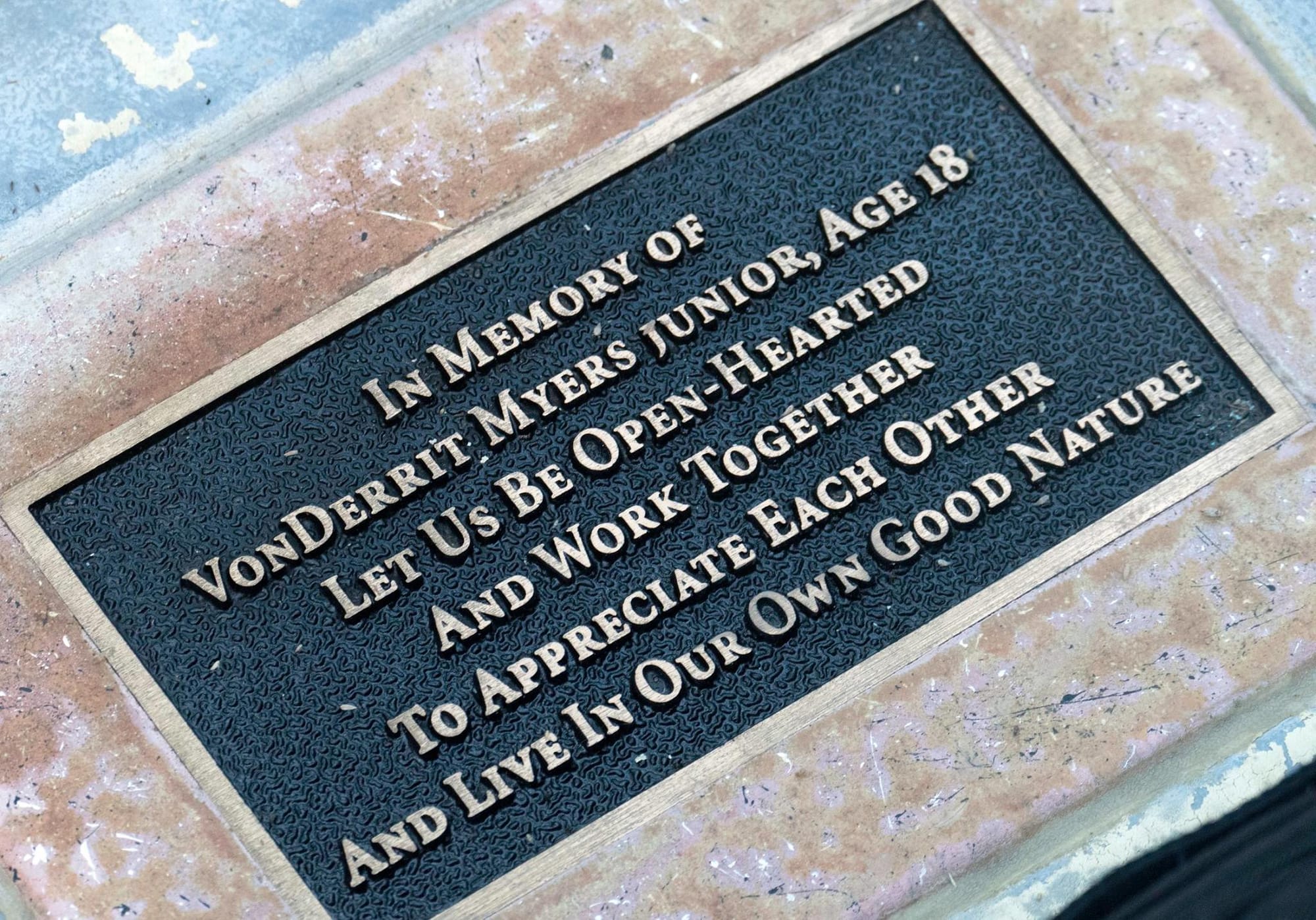
Flora Place gained a private security force along the way, and that force operated as enforcers for the control of streets at the behest of the wealthiest property owners in the neighborhood. Again, Shaw is a Democratic stronghold that today has been seen a locus of “progressive” political power. Between 2000 and 2020, the white population of the neighborhood grew by 46% while the Black population declined by 67%. The total population has dropped by 16% as multi-family housing has been converted into single dwelling housing by wealthy residents. The streets of Shaw today are even less likely to be walked by Black bodies than they were in 2014, making the possibility for a violent encounter with the Flora Place private police even more likely.
Should the behavior of the Flora Place landowners seem extreme, one needs to recall that St. Louis is a city where an entire cultural organization devoted to social domination of the free use of the street continues to persist. In 1877, after 10,000 workers successfully commandeered downtown streets in the national General Strike, the workers’ commune governed the city for nearly a week. As detailed by Devin Thomas O’Shea in his new book The Veiled Prophet: Secret Societies, White Supremacy and the Struggle for St. Louis (2026), a cadre of civic elites and aspiring upwardly-mobile upper middle-class businesspeople – many former Confederate soldiers or sympathizers – former the Veiled Prophet Organization which staged an annual society ball and public parade on the same streets dominated by the workers. A veiled business elite presided over the whole affair, which was designed to intimidate workers and Black St. Louisans alike – the Homeland asserted its dominion over determining who had the right to claim the city.
Both Pretti and Good were white, and proclamations of their innocence have met wider public acceptance than righteous claims that Mike Brown, VonDerrit Myers, Jr., George Floyd and many other Black people killed by police shootings were also assassinated for standing against a corrupt authoritarian order. For America to truly reckon with the violence of Minneapolis and the violent occupation by Trump’s federal forces, it must also acknowledge the myriad ways in which local governments and their police officers have engaged in the summary execution of persons claiming the right to occupy the street and thus determine who the state really is. Trump’s MAGA project did not gallop out of a vacuum, but instead built itself out of a long history of American authoritarianism built around racialized systems of property (and thus rights) creation.
"Whose Streets? Our Streets!"
Two years after VonDerrit Myers, Jr. fell dead on the streets of the Shaw neighborhood, St. Louis formally submitted a proposal to relocate the western headquarters of the National Geospatial-Intelligence Agency (NGA) in the city’s St. Louis Place neighborhood. Here was a damaged but resilient quarter of a majority-Black neighborhood ravaged by years of deliberate neglect and targeted demolition. With an alternative site 12 miles east adjacent to Scott Air Force Base in Illinois, a bipartisan coalition of politicians championed moving the NGA to a site that would require dispossessing 120 Black households, several churches and a few small and medium businesses. NGA chose the St. Louis Place site under the presidency of Barack Obama.
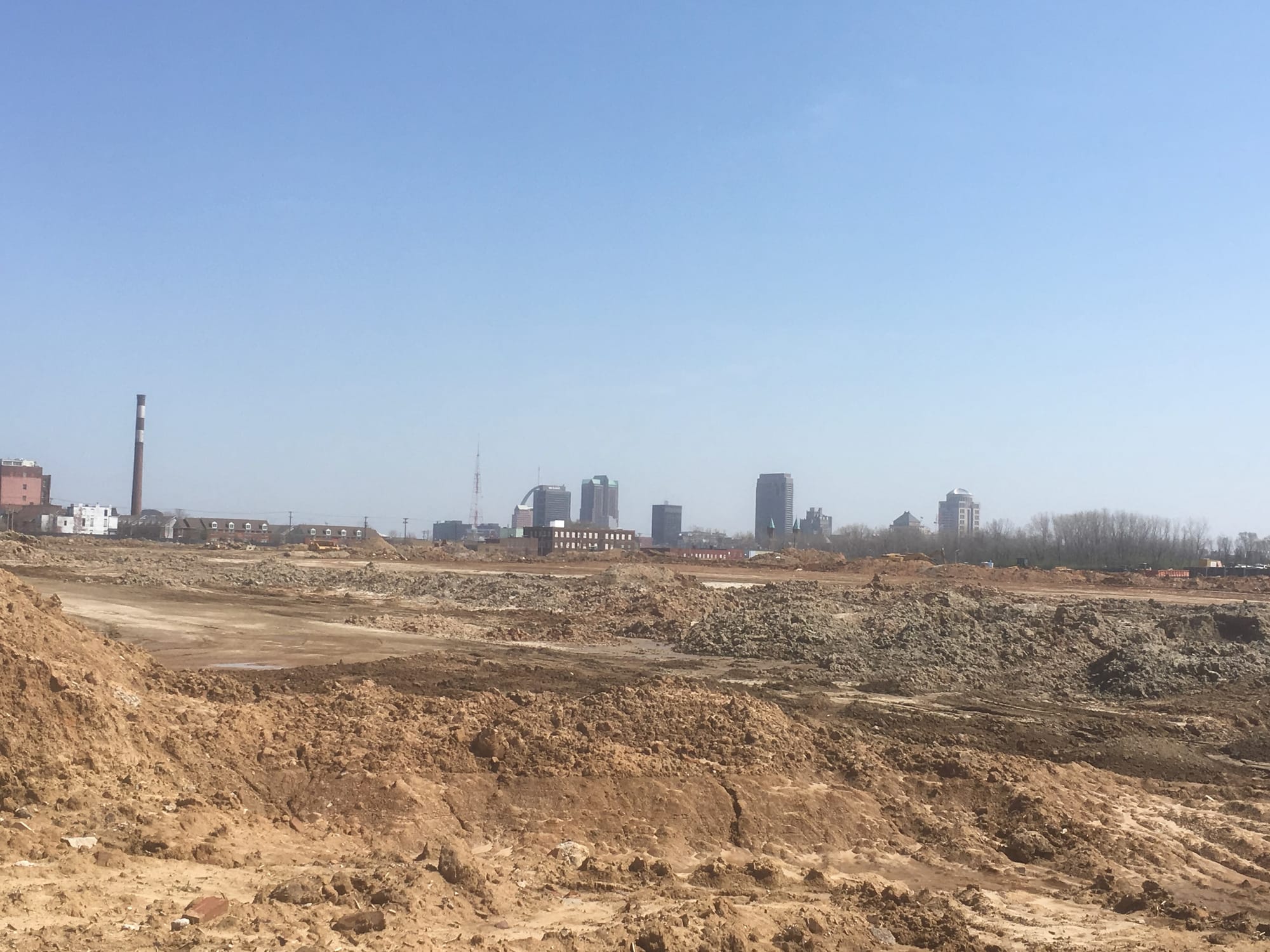
The NGA headquarters required the clearing of every last building, utility and street from St. Louis Place’s southwestern area. The clearance area of 100 acres erased not only the population but the system of streets by which people could assert their claims to place. After protests including hunger strikes fell on deaf ears, a Democratic president directed the assault on the rights of the people of St. Louis Place to determine their direction of the nation-state of which they supposedly were a part.
One year later, NGA assisted the Israeli Defense Forces (IDF) in training for geospatial analysis. At the NGA western headquarters, the city streets would dissolve until the site reformulated would become a fenced-in, fortified superblock – akin to the French bastide. Within a decade, the IDF would pulverize the streets of Gaza until many of them did not exist, alongside a genocidal campaign of killing Palestinians. The removal of streets forestalled circulation but also assembly. Without streets, an urban people becomes truly stateless.
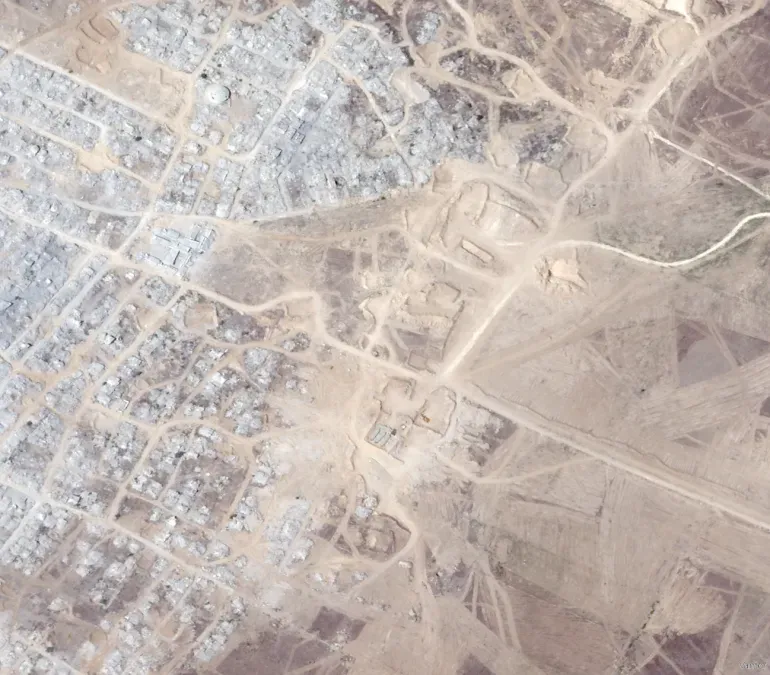
The street may be an instrument of administrative control in its inception, but it also is one of the tools of the master easily used by ordinary people in their quests to rebel, revolt and declare their new states. Seeing the street as both a physical and virtual layered realm, it is hard to imagine how the weak Trump regime will ever succeed to fully control the streets of America. Yet the histories of local constraint of streets outside of the MAGA agenda show a wider culpability in the project of trying to make the Homeland a physically-defensible, real space instead of a deranged and violent fantasy.
Americans need to realize that the street is the space on which assembly can topple tyrants, but only if human rights are asserted over the rights of property and the police orders that protect them. Mimi Sheller reminds us that “[t]he capacity to move and the coercive power of stopped movement, detention or imprisonment are fundamental dimensions of human rights and justice.”[2] To reach the future we crave, we must be able to move. To move, we must have streets. And to have streets, we must confront the forces that seek to dominate them – all of the forces, even our own.
[1] Sylvia Federici, Re-Enchanting the World: Feminism and the Politics of the Commons (Oakland: PM Press, 2019), p. 89.
[2] Mimi Sheller, Mobility Justice: The Politics of Movement in an Age of Extremes (New York: Verso, 2018), p. 67.