While We Wait

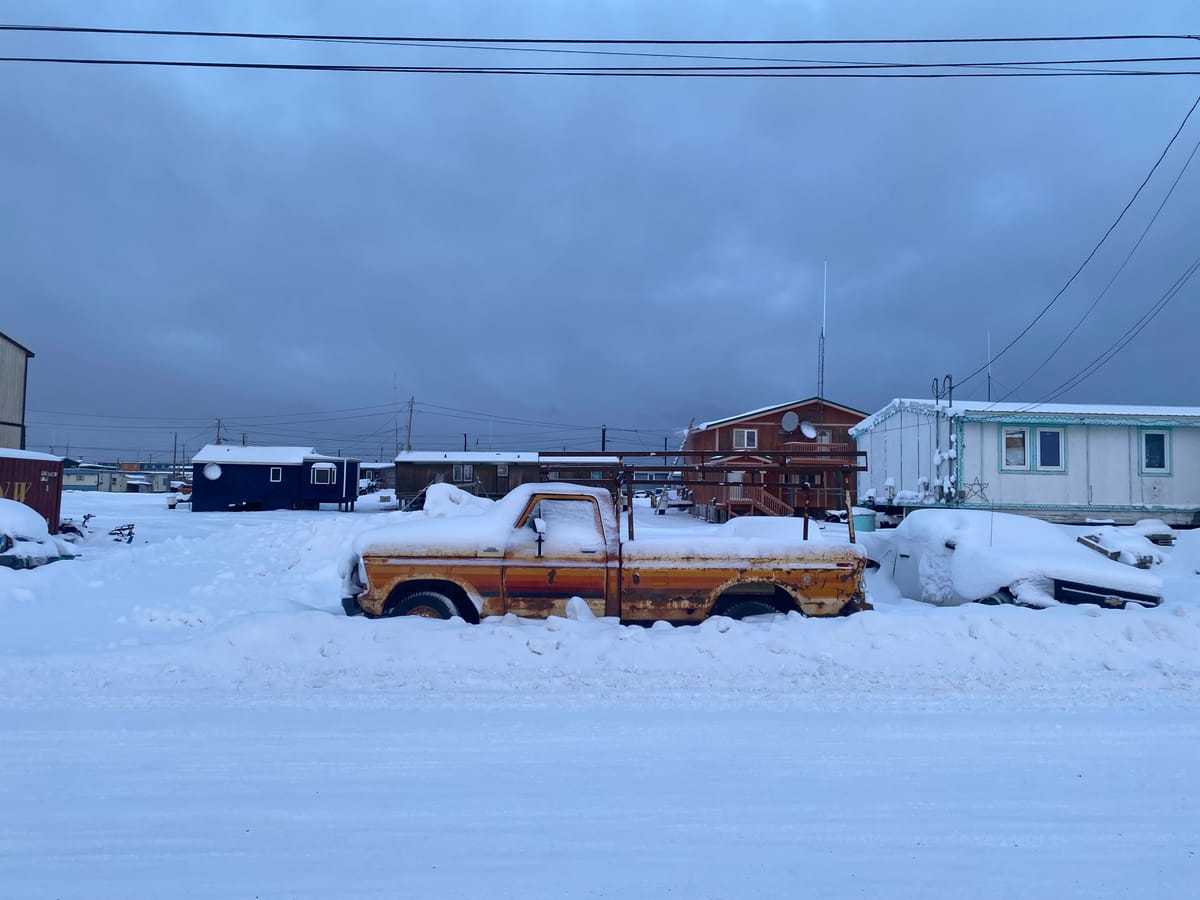
While we wait to see if the threat of the US invasion on Greenland will materialize, I think about the Arctic.
*
I moved to Utqiaġvik, Alaska in 2022. I had just excepted my first position after grad school, becoming the one person English Department at Iḷisaġvik College, the northernmost community college in North America. The ladies at the Iñupiat Heritage Center across the street from where I lived used to make fun of me, or perhaps the college, pointing out how amusing it is that they had to import an immigrant to teach the natives English. I didn’t come to teach anybody English. I came because I wanted to be a part of an America where English is guest, and multilingualism a fact of life. I learned some elementary Iñupiaq. I was very bad at it. Failing at it was a was an invaluable lesson in getting acquainted with my limitations. I will try again.
It has been a childhood dream of mine to live in the Far North. Born early in January, I was a winter child. As a figure skater I have developed a tender intimacy with ice. Why do we love the things we love? Does it matter? Or does it only matter how we love them?
Living in the Arctic has taught me how to love it differently than dreaming about it. I taught me to be more deliberate with what kind of new-comer I want to be. People move through the earth all the time – migration is a fact of life. But we move in different ways. Some are more damaging than others.
There is a story people in Utqiaġvik like to circulate. Some time ago – Iñupiaq time sensibilities are a little different from mine, and make the past, even a very deep past, feel closer – three people were stranded on an island in the Arctic Ocean together. Two British men, whalers, and an Iñupiaq woman. Not much remains of the story but it’s moral: the men died of scurvy because they made fun of the woman for eating the seagulls raw.
The conviction that it is the task of the Empire to export culture to places where it has not yet been discovered has been an essential tool of British colonialism since its conception. Many of us know that it has always been a lie, but it’s one that often remains hidden. The Arctic has a way of bringing things to the surface, and exposing empty competence for what it is. One of my favorite things about the Arctic is that it is a place where arrogance goes to die.
*
Franklin's lost expedition was a part of the British search for the Northwest Passage – a channel that would connect the Atlantic and Pacific Oceans, opening an Arctic trading route between Europe and Asia. Led by Captain Sir John Franklin the expedition of 129 men and two ships – HMS Erebus and HMS Terror – sailed into the Canadian Arctic in 1945, finding itself icebound just south of King William Island within a year of sailing. The crew abandoned the ships after a year of being stranded, and vanished from the face of the earth. Historical research and Inuit testimonials suggest that there were no survivors. Malnutrition, scurvy, led poisoning, cannibalism. The Northwest passage was first successfully traversed by Roald Amundsen’s slender sloop Gjøa in 1906 under the flag of Norway. The dreamed-of trading route was never established. HMS Erebus and HMS Terror rest at the bottom of Canadian territorial waters, just south of King William Island.
Franklin's lost expedition did not destroy the British Empire. It did, however, serve as a useful reminder of the limits of its omnipotence. For the British was, and remains, an important sight of humiliation.
In 1864 Sir Edwin Landseer portrayed it in an oil-on-canvas. It bears the title Man Proposes, God Disposes. On the background of sea ice, carcasses, and broken masts two polar bears feast on human flesh. Hanging in the Royal Holloway collection at the University of London the painting is rumored to be haunted, or curse. I has been said that it drove one of the students to suicide, and his last words were “the polar bears made me do it.” While these stories resist verification, the paining continues to carry an air of poorly articulated anxiety. It is often covered with a Union Jack not to disturb the students during exam periods. There is a sense that the message it carries – one about the cost of arrogance – is more than the British gaze can stand on most days. The powerful like to portray themselves as invincible. To be portrayed otherwise is unbearable.
In the opening episodes of David Kajaganich’s TV show The Terror – a fictional dramatization of Franklin's lost expedition and the search for it – we are asked to watch the officers dine. It is early in the voyage, nothing bad has happened yet. Nobody’s character has yet been tested by difficulty and they are all still enjoying the privilege of their won delusions. In an elongated, at times unbearable, scene we listen to men brag about their competence as men, seamen, soldiers. In time, we will learn that most of these accounts are fabricated. We will watch scurvy and malnutrition reshape their faces and their attitudes, tilting the adaptable amongst them towards humbleness, and others towards madness. We will watch Sir Franklin, whom we will get to know as arrogant and irresponsible, die in what we will assume is a polar bear attack. What will remain of his vanity is a little leg in an elegant sock adorned with a ribbon. Sic transit gloria mundi.
One of my favorite things about the Arctic is that it can’t accommodate a mirage of competence.
In Tony Hoagland’s 1987 poem The Delay the voice of a poet ponders on the images of polar expeditions he is looking though in the dead of night:
Men / who ran away from what they should have done / to carve a name out for themselves / in a hunk of planetary ice. / In the yellowed, hundred-year-old photographs, / they still look arrogant and brash / in their brand new bearskin coats and beards. / They might be Nordic gods, posing on a ridge / above a caravan of Eskimoes and sleds. / But I wonder how they looked months later, / when the emptiness they wanted / such a close inspection of / had eaten out their cheeks, eaten up / the part of them made out of words, / and left the bony, silent men themselves, / walking over fields of sea-green, / thousand-year-old ice and wind. There are / other photographs--the Welshman / kneeling, as if to pray, / at the carcass of a seal; Peary / weeping at the stump of his left hand. / There are other plot-lines and motifs. / But the story stays the same: some of us / would rather die than change. We love / what will destroy us / as a shortcut through this world / which would bend and break us slowly / into average flesh and blood. / I close the book and listen to the noises / of an ordinary night. A chair that scrapes. / The cricket, like a small appliance / singing. The air of every room / so ponderously still. I can tell / that it is not too late. / And then I think this ordinariness / will crush me in its fist. / And then I wish it would.
One of my favorite things about the Arctic is that it – like all difficulty – doesn’t support lies.
*
The powerful like to portray themselves as invincible. It flatters their sense of self, I am sure, but it is also a strategy. It is deliberately discouraging. It makes resistance feel impossible and out of reach. It makes those with less power, even when they are in great numbers, feel like they have no say their own destinies. This is why stories about unexpected or unlikely victories are important, and it is important to remember that northern warfare often rewarded with unexpected outcomes.
In 1812 Napolen’s Russian Campaign saw half a million soldiers march through Western Russia, facing an army less than half its size. Before arriving at Borodino, just outside of Moscow, Napoleon lost half of his manpower to weather and malnutrition. He arrived at Moscow with 100,000 men, fining it deserted and set on fire by Fyodor Rostopchin. In an attempt to preserve his troops, commander Mikhail Kutuzov decided not to defend the city. Refusing to retreat Napoleon suffered a defeat not by enemy forces, but by typhus, snow, and enraged local population.
During the Battle of Suomussalmi in the Winter War of 1939, 11,000 Finnish ski troops defended two Soviet mechanized divisions of 45,000.
In 1941 The Third Reich launched Operation Barbarossa, an invasion of the Soviet Union. After capturing Kiev, Kharkov, Rostov-on-Don, Smolensk, and much of Crimea in the summer and fall, the Operation, much like Napoleon’s Russian Campaign, came to a halt at the gates of Moscow due to logistical issues caused by mud, snow, and disease.
The Far North requires and rewards true intimacy. To know it well, and to be able to strategize around its unpredictability as if it were predicable is often a bigger asset than extensive manpower or expensive military equipment, particularly because the technology doesn’t work particularly well in the cold. The history of northern warfare is a history of exception. This doesn’t guarantee any outcome, as no outcome is ever guaranteed, but thinking about it might serve as a welcome remedy against learned helplessness.
*
In 1958 United States Atomic Energy Commission proposed an infrastructural project in the Arctic championed by Edward Teller, also known as the father of the hydrogen bomb. Project Chariot was designed to answer the question if nuclear devices can be used in civil engineering. Atomic Energy Commission sought to build a harbor at Cape Thompson, Alaska, in a series of detonations. The harbor would connect Northwestern Alaska with commercial networks of mineral exchange. The Commission say the land as “empty,” and those few living there unable to form a successful opposition.
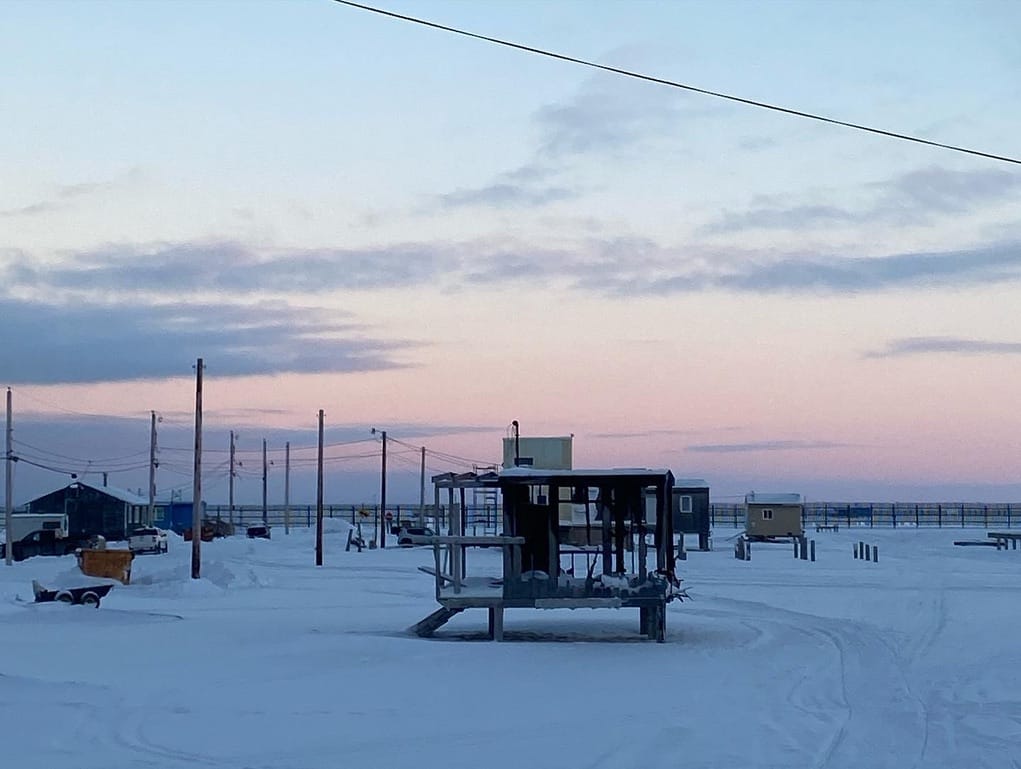
Lead by Howard Rock, an Iñupiaq artist and editor, leaders from 20 villages that would have been affected by the project gathered met to discuss strategy met in 1961. They pushed for further studies, that showed that nuclear experimentation would contaminate the lichens, and though them the rest of the food chain – the caribou that it the lichens, and the people who eat the caribou. A united resistance of the local communities produced enough pressure for the Atomic Energy Commission to back down and abandon the project in 1962.
The assembly of village leaders was named "Iñupiat Paitot," or "The People's Heritage." It served as a source of unification.
In October 1962 Howard Rock launched The Tundra Times, the first Iñupiaq newspaper. It, too, served as a source of unification.
In December 1971 President Richard Nixon signed into law The Alaska Native Claims Settlement Act, the largest land claims settlement in the US history that established Alaska Native claims to the land by transferring titles to twelve Alaska Native regional corporations. It wouldn’t have been achieved without unification.
*
Hiding in plain sight, lichens are an essential part of the Arctic ecosystem. Dainty webs of green growth often mistaken for plants, they feed hears of caribou on their way across the tundra.
Perhaps unexpectedly, the study of lichens contributed to some of the deepest paradigmatic shits in our understanding of life on earth.
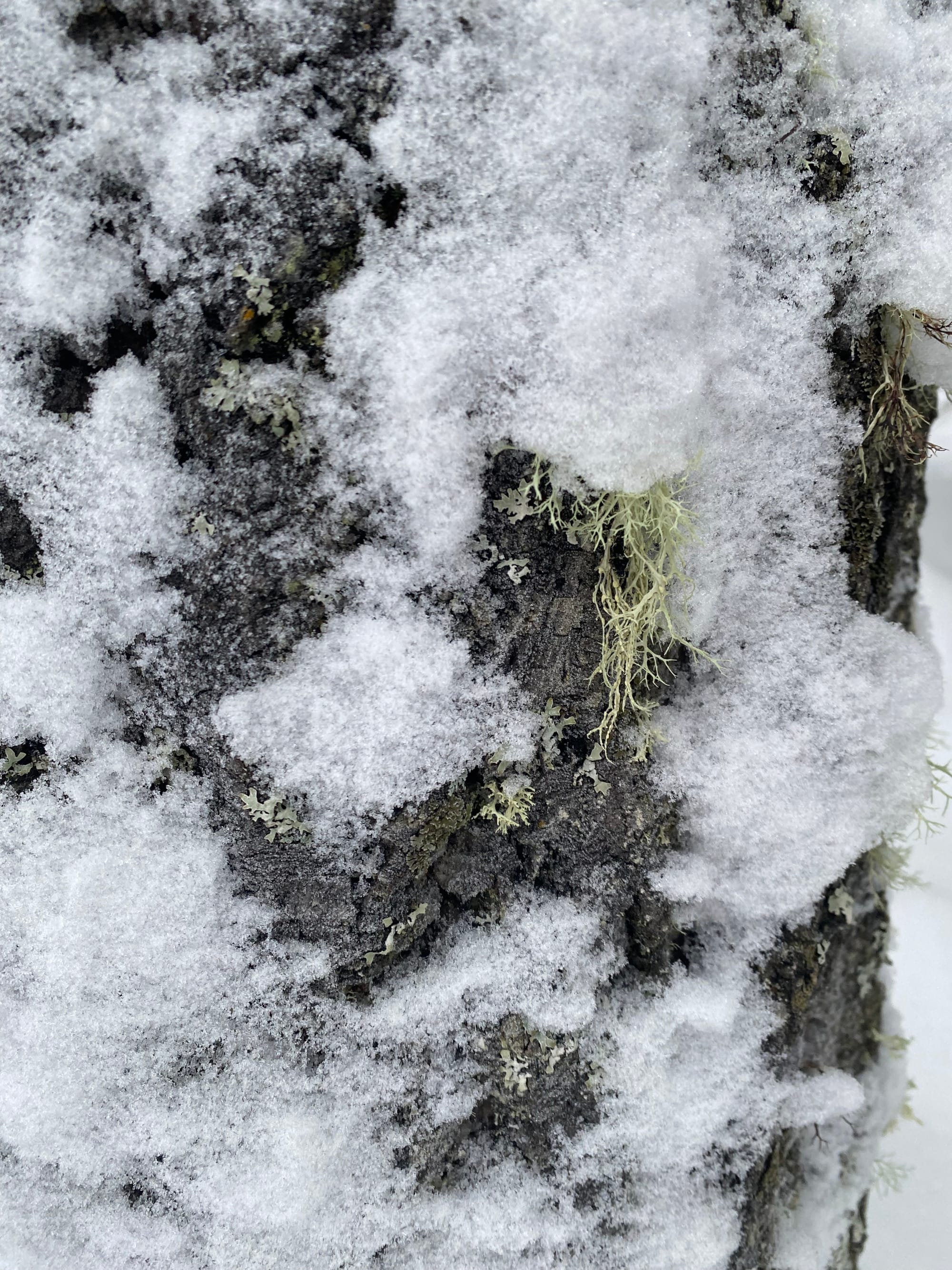
In 1867 a Swiss botanist Simon Schwendener proposed the dual hypothesis on lichens, arguing that lichens are not a single organism, but a compound of fungi and algae. Going against the grain of how we understand individuality his hypothesis was initially rejected and famously mocked by Beatrix Potter – the author of children’s books featuring rabbits in clothing. It has since been confirmed to be true, if incomplete – not only are lichens composite creatures, they consist of more then just fungi and algae, but also bacteria, and yeast, complicating the distinction between an organism and an ecosystem.
In her 1967 article “On the Origin of Mitosing Cells” Lynn Margulis proposed an endosymbiont hypothesis, arguing that symbiosis we see in the composite structure of lichens plays a more essential role in evolution than the “survival of the fittest.” While Darwinism, social or otherwise, continues to assert the conviction that life is rooted in competition as a part of the common sense, Margulis’ hypothesis tells a different story. Lichens are world’s sturdiest organism. They are likely the candidate to survive a prolonged journey through outer space. Their longevity is a direct result of their cooperative nature. They survive the unsurvivable because they are unified.
*
In my four years in Alaska I have become a cross country skier. In wintertime, weather permitting, I wake up every other day before work and move though the loops in Kincaid Park.
Cross country skiing is thought to have been developed in the sixth century by Sami hunters. It is an endurance sport designed to track large prey over long distances. One of most demanding forms of movement, it is an exercise in how to find ease in difficulty. It has taught me how not to give up when I feel like I can’t go any further – how to optimize my movement, to remove the unnecessary, to slow down without stopping.
It’s also allowed me to develop an intimacy with the land I inhabit though regular practice – to internalize the map of the trails I ski, to understand how the changes in temperature make the snow behave, to observe the weather, memorize its cycles, and anticipate what once felt coincidental. It’s become my most cherished practice. It made the love I have always felt for the place where I live feel grounded in repetition, knowledge, and care.
While we wait to see if the threat of the US invasion on Greenland will materialize, I think about the Arctic as a teacher. I think about those unwilling to learn, and their destinies. The word justice comes to mind.